
Golconda diamonds need no introduction. Like timeless superstars on the red carpet, these legendary precious stones never lose their allure and never fail to command attention. Golconda diamonds refer to diamonds that originated from the legendary mines in the Golconda region of India.
Reputed auction houses such as Sotheby’s and Christie’s are regarded as pioneers in hosting high-profile auctions for high-value assets, including the coveted Golconda diamonds. Interestingly, a few Golconda diamonds have never appeared at auctions. Some were transferred, sold, or lost long before high-profile auctions became the norm, while others have remained elusive for centuries, with their transfers and sales taking place in utmost privacy.
Diamond mines in the Golconda region were highly resourceful – this was centuries ago. The Nizams were controlling the Golconda diamond mines before, the Indian government took over the region including the diamond mines as a part of India – this happened in the year 1948.
A few all time legends from the world of diamonds, originated in the Golconda mines – the Koh-i-Noor Diamond, Seraphim Blue Diamond, Regent, Golconda Blue Diamond, Dresden Green and Orlov are perfect examples. The famed Kollur, Paritala, and other Golconda mines ceased commercial level mining centuries ago. The diamond deposits in the region were largely depleted by the 18th century – that was when, organized mining stopped.
Golconda diamonds that make their appearance at highly publicized auctions by Christie’s and Sotheby’s often achieve legendary status. These rare events attract astonishingly high bids from collectors and connoisseurs worldwide.
Listing some of the most renowned Golconda diamonds that achieved spectacular results at auctions hosted by Christie’s and Sotheby’s – most of the auctions were organized by Christie’s. These were The Princie Diamond, Archduke Joseph Diamond, The Idol’s Eye and the Mirror of Paradise & Arcot II diamonds.
GOLCONDA DIAMONDS NEVER AUCTIONED
A few known Golconda diamonds have never appeared at public auctions. Their transfers or sales took place privately, with no involvement of any public auction house. This could be the reason why a few Golconda diamonds, with an enviable provenance maintained a low profile.
The Seraphim Blue Diamond is a great example. The diamond was worn by the first Nizam of Hyderabad in a lavish turban ornament – the time frame was 1724. The second Nizam apparently gave the gorgeous blue diamond, to the French. Not as a gift or as a gesture of goodwill but, in return for military support. The journey of the Seraphim Blue Diamond, remained off the records. A few diamond experts claim that centuries later, the historic diamond is now part of a Russian collection.
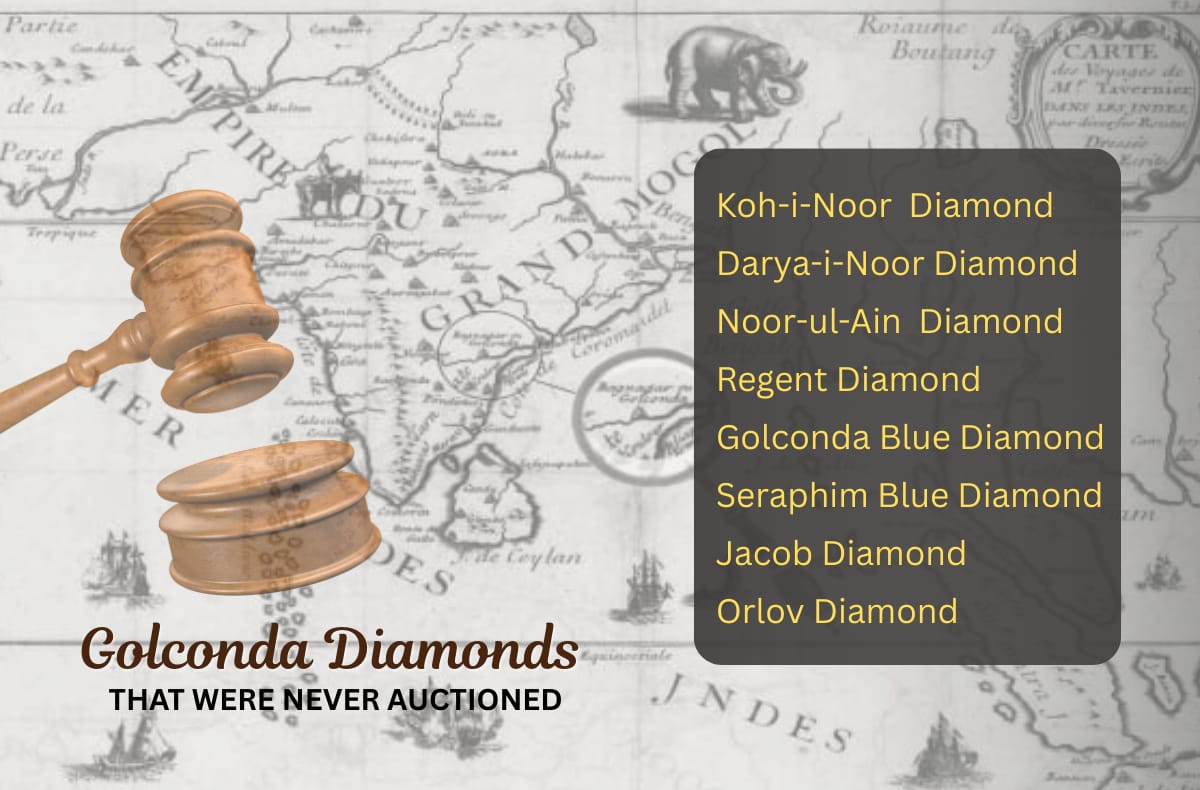
Here are a few historical Golconda diamonds that, based on public records, have never been sold at a public auction as of August 2025. While some of these diamonds have become state property, showcased as museum pieces, or transferred via private sale or treaty – they have therefore never made it to a Sotheby’s or Christie’s diamond auction.
| Name Of The Diamond | Mined At |
| Koh-i-Noor | Golconda |
| Darya-i-Noor | Golconda |
| Noor-ul-Ain | Golconda |
| Regent | Golconda |
| Golconda Blue | Golconda |
| Seraphim Blue | Golconda |
| Jacob (Nizam) | Golconda |
| Orlov | Golconda |
| Dresden Green | Golconda |
INTERESTING BRIEFS
Short notes related to some of the Golconda diamonds mentioned above, highlights that underline their characteristics.
The Golconda Blue Diamond
The diamond auction circuit was all of sudden informed of a lesser known blue diamond from the Golconda mines. The messenger in this case was none other than Christie’s. A much touted publicity blitz, announced an auction for the Golconda Blue Diamond in May 2025. A provenance that included royalty but a relatively short provenance, that began in the early 1900s.
A surprise auction and then, severe disappointment followed. Weeks before the diamond auction, Christie’s announced a cancellation of the auction. Reasons given but, doubts and suspicions persisted.
The Koh-i-Noor Diamond
The Koh-i-Noor diamond (Persian for “Mountain of Light”) is one of the best known diamonds in history, both for its beauty and for the legends and disputes surrounding it. The Koh-i-Noor is believed to have been mined in the Golconda mines of the Deccan plateau (modern-day Andhra Pradesh, India), the same region that produced several legendary diamonds.
The ’possible’ Golconda origin mentioned for the Koh-i-Noor Diamond, holds significance. The point is that many diamonds discovered centuries ago, did not have access to modern technics, expertise and advanced equipment to help determine their origin – with sufficient clarity. On the other hand diamonds revealed in recent times, like the Golconda Blue Diamond and the Seraphim Blue Diamond – would have been put through a more advanced and thorough testing process. This is just an observation and should be kept in mind.
The Koh-i-Noor Diamond which is now part of the British Crown Jewels, entered the Royal Collection via the Treaty of Lahore (1849), not through an auction. Britain has on multiple occasions justified its decision – not to return the historic diamond to India. They have emphasized the fact that, this was an official transfer and not a ‘theft’ or ‘forced’ takeover.
The Seraphim Blue Diamond
An elusive Golconda diamond that has been elusive for a few centuries. It is claimed that the first Nizam of Hyderabad (Asaf Jah I) who reigned from 1724 to 1748, wore the Seraphim Blue Diamond in an exotic turban ornament. The fine blue Golconda diamond exited the treasury of the Nizams when, Asaf Jah II the second Nizam of Hyderabad used it as a mode of payment with the French. The Nizam was promised military support in return.
In recent times a number of reports across multiple platforms, have reported a similar narrative about the Seraphim Blue Diamond. Strong indications are that, the diamond is currently part of a Russian collection. A few diamond investors who claim to have inspected the diamond in Russia, narrated a story that seems to give credence to the reports published earlier. While the diamond that is estimated to have a weight in the 7 to 9 carats, is not very large – it has an enviable provenance, that could help it command a record breaking price per carat.
GOLCONDA DIAMOND AUCTIONS
Golconda diamonds auctioned by major houses such as Sotheby’s and Christie’s, consistently attract some of the world’s most prominent bidders. The growing rarity of diamonds from the historic Golconda mines appearing on the market ensures that, these precious stones command truly exorbitant prices.
An interesting observation is that diamond collectors looking to sell their prized possessions are increasingly opting for private sales rather than public platforms such as auctions. This approach often appeals to buyers who prefer to maintain a low profile. Additionally, the considerable commissions charged by prestigious auction houses may also encourage sellers to favor private transactions.